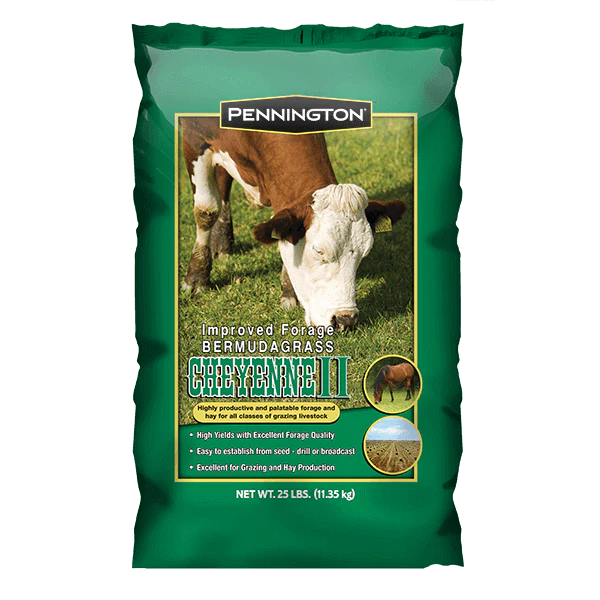
(Limited Availability 2026) Cheyenne II Bermuda Grass Seed
Limited Availability for 2026 Due to Bad Harvest
PLANTING:
- Rate: 15 lbs./acre drilled or broadcast.
- Depth: Plant no deeper than 1/8 inch.
- Date: Late spring - early summer when soil temperatures are 65 degree Fahrenheit or above.
- Fertilization: Apply 20-30 lbs./acre nitrogen as a starter fertilizer at planting. Lime soil to 6.0 pH and follow soil test for N-P-K.
Competition from other grasses and weeds is the number one reason for bermudagrass stand failure. Taking steps to reduce this competition will increase your chances of success. Don't get in a hurry to plant. If soil temperature is not 65 degrees Fahrenheit or higher at a depth of 4", bermudagrass will not germinate. When the seed does germinate it will be weaker and more subject to disease.
For No-Till Drill
- Be sure seed is not dropping too deep; 1/8"or less is ideal. One method to prevent deep planting is to pull the drill’s drop tubes out of the openers and let the seed fall behind the opener to be pressed into the loosened soil by the press wheel.
- Be sure that existing residue is not too thick for seedlings to emerge and that the seed is making soil contact beneath the residue.
For Clean-tilled Ground — Broadcast
- Prepare the ground well in advance. This allows the first flush of crabgrass and other competition to germinate that can be killed with a non-selective herbicide like glyphosate before planting Cheyenne II.
- Clean-till the area with a disk, then level and smooth the area. Use a cultipacker to prepare a very firm seedbed before planting. Several passes may be necessary to achieve proper firmness.
- Broadcast the seed and cultipack once more to get good seed to soil contact. Bermudagrass seed will not germinate in a fluffy, loose seedbed.
- Take care to place the seed at the proper depth of 1/8” or less.
MANAGEMENT:
To establish, delay grazing or hay cutting until forage is 8” to 10” tall. Do not graze or clip for hay shorter than 2”. When new plants begin to spread, apply 50-60 lbs. of nitrogen per acre. After the stand is established, apply 50-75 lbs. of nitrogen per acre after each cutting of hay. If grazed, apply up to 150 lbs. /acre a year in split applications throughout summer. Rotate animals more often during periods of drought stress. Last nitrogen fertilizer application each year should not be applied less than 6 to 8 weeks before a killing frost to prevent winter kill. Leave at least 4” of growth entering winter. Maintaining medium to high levels of phosphorus and potassium in the soil throughout the growing season is key to disease prevention and bermuda stand survival. If season ending soil levels are low, apply phosphorus and/or potassium fertilizer per soil test recommendation in late summer/early fall to help prevent winter injury. In first year bermuda, late cuttings of hay (6-8 weeks before a killing frost) and/or overseeding of winter annuals can weaken and potentially thin the stand. Once the bermuda is well established (2nd year and older stands), overseeding of winter annuals is acceptable.
Original: $21.35
-70%$21.35
$6.41(Limited Availability 2026) Cheyenne II Bermuda Grass Seed
Limited Availability for 2026 Due to Bad Harvest
PLANTING:
- Rate: 15 lbs./acre drilled or broadcast.
- Depth: Plant no deeper than 1/8 inch.
- Date: Late spring - early summer when soil temperatures are 65 degree Fahrenheit or above.
- Fertilization: Apply 20-30 lbs./acre nitrogen as a starter fertilizer at planting. Lime soil to 6.0 pH and follow soil test for N-P-K.
Competition from other grasses and weeds is the number one reason for bermudagrass stand failure. Taking steps to reduce this competition will increase your chances of success. Don't get in a hurry to plant. If soil temperature is not 65 degrees Fahrenheit or higher at a depth of 4", bermudagrass will not germinate. When the seed does germinate it will be weaker and more subject to disease.
For No-Till Drill
- Be sure seed is not dropping too deep; 1/8"or less is ideal. One method to prevent deep planting is to pull the drill’s drop tubes out of the openers and let the seed fall behind the opener to be pressed into the loosened soil by the press wheel.
- Be sure that existing residue is not too thick for seedlings to emerge and that the seed is making soil contact beneath the residue.
For Clean-tilled Ground — Broadcast
- Prepare the ground well in advance. This allows the first flush of crabgrass and other competition to germinate that can be killed with a non-selective herbicide like glyphosate before planting Cheyenne II.
- Clean-till the area with a disk, then level and smooth the area. Use a cultipacker to prepare a very firm seedbed before planting. Several passes may be necessary to achieve proper firmness.
- Broadcast the seed and cultipack once more to get good seed to soil contact. Bermudagrass seed will not germinate in a fluffy, loose seedbed.
- Take care to place the seed at the proper depth of 1/8” or less.
MANAGEMENT:
To establish, delay grazing or hay cutting until forage is 8” to 10” tall. Do not graze or clip for hay shorter than 2”. When new plants begin to spread, apply 50-60 lbs. of nitrogen per acre. After the stand is established, apply 50-75 lbs. of nitrogen per acre after each cutting of hay. If grazed, apply up to 150 lbs. /acre a year in split applications throughout summer. Rotate animals more often during periods of drought stress. Last nitrogen fertilizer application each year should not be applied less than 6 to 8 weeks before a killing frost to prevent winter kill. Leave at least 4” of growth entering winter. Maintaining medium to high levels of phosphorus and potassium in the soil throughout the growing season is key to disease prevention and bermuda stand survival. If season ending soil levels are low, apply phosphorus and/or potassium fertilizer per soil test recommendation in late summer/early fall to help prevent winter injury. In first year bermuda, late cuttings of hay (6-8 weeks before a killing frost) and/or overseeding of winter annuals can weaken and potentially thin the stand. Once the bermuda is well established (2nd year and older stands), overseeding of winter annuals is acceptable.
Product Information
Product Information
Shipping & Returns
Shipping & Returns
Description
Limited Availability for 2026 Due to Bad Harvest
PLANTING:
- Rate: 15 lbs./acre drilled or broadcast.
- Depth: Plant no deeper than 1/8 inch.
- Date: Late spring - early summer when soil temperatures are 65 degree Fahrenheit or above.
- Fertilization: Apply 20-30 lbs./acre nitrogen as a starter fertilizer at planting. Lime soil to 6.0 pH and follow soil test for N-P-K.
Competition from other grasses and weeds is the number one reason for bermudagrass stand failure. Taking steps to reduce this competition will increase your chances of success. Don't get in a hurry to plant. If soil temperature is not 65 degrees Fahrenheit or higher at a depth of 4", bermudagrass will not germinate. When the seed does germinate it will be weaker and more subject to disease.
For No-Till Drill
- Be sure seed is not dropping too deep; 1/8"or less is ideal. One method to prevent deep planting is to pull the drill’s drop tubes out of the openers and let the seed fall behind the opener to be pressed into the loosened soil by the press wheel.
- Be sure that existing residue is not too thick for seedlings to emerge and that the seed is making soil contact beneath the residue.
For Clean-tilled Ground — Broadcast
- Prepare the ground well in advance. This allows the first flush of crabgrass and other competition to germinate that can be killed with a non-selective herbicide like glyphosate before planting Cheyenne II.
- Clean-till the area with a disk, then level and smooth the area. Use a cultipacker to prepare a very firm seedbed before planting. Several passes may be necessary to achieve proper firmness.
- Broadcast the seed and cultipack once more to get good seed to soil contact. Bermudagrass seed will not germinate in a fluffy, loose seedbed.
- Take care to place the seed at the proper depth of 1/8” or less.
MANAGEMENT:
To establish, delay grazing or hay cutting until forage is 8” to 10” tall. Do not graze or clip for hay shorter than 2”. When new plants begin to spread, apply 50-60 lbs. of nitrogen per acre. After the stand is established, apply 50-75 lbs. of nitrogen per acre after each cutting of hay. If grazed, apply up to 150 lbs. /acre a year in split applications throughout summer. Rotate animals more often during periods of drought stress. Last nitrogen fertilizer application each year should not be applied less than 6 to 8 weeks before a killing frost to prevent winter kill. Leave at least 4” of growth entering winter. Maintaining medium to high levels of phosphorus and potassium in the soil throughout the growing season is key to disease prevention and bermuda stand survival. If season ending soil levels are low, apply phosphorus and/or potassium fertilizer per soil test recommendation in late summer/early fall to help prevent winter injury. In first year bermuda, late cuttings of hay (6-8 weeks before a killing frost) and/or overseeding of winter annuals can weaken and potentially thin the stand. Once the bermuda is well established (2nd year and older stands), overseeding of winter annuals is acceptable.